1. Executive Overview: Engineering Mandate for C# .NET Windows Application Industrial Alarm Engine
Modern industrial manufacturing facilities cannot afford unscheduled downtime, unmanaged alarm flooding, or blind spots on the shop floor. In modern high-throughput manufacturing plants—spanning automotive stamping, continuous chemical processing, pharmaceutical cleanrooms, and food packaging—alarm management is the definitive operational bridge between physical PLC controllers and rapid human intervention.
When plant lines experience sudden threshold trips, mechanical jams, or communication timeouts, conventional setups often fail: control rooms become inundated with dozens of unprioritized alarms within seconds, creating severe operator cognitive fatigue. Implementing an engineered C# .NET Windows Application Industrial Alarm Engine provides deterministic prioritization, sub-second signal conditioning, and verifiable operator accountability.
Industrial Statistics & Reliability Benchmarks
- Downtime Costs: According to Aberdeen Research, unplanned machine stoppages in discrete and process manufacturing cost an average of $260,000 per hour ($4,300+ per minute).
- Alarm Fatigue Elimination: Facilities deploying structured alarm rationalization achieve an 82% to 94% reduction in nuisance alarm notifications during routine line changeovers and startup transients.
- Mean Time to Repair (MTTR): Fast-tracked root cause annunciation slashes operator diagnostics time from 38 minutes down to under 4.5 minutes.
- Target Latency: Critical alert dispatch latency benchmarks reach < 5 ms with an availability factor of .NET 8.

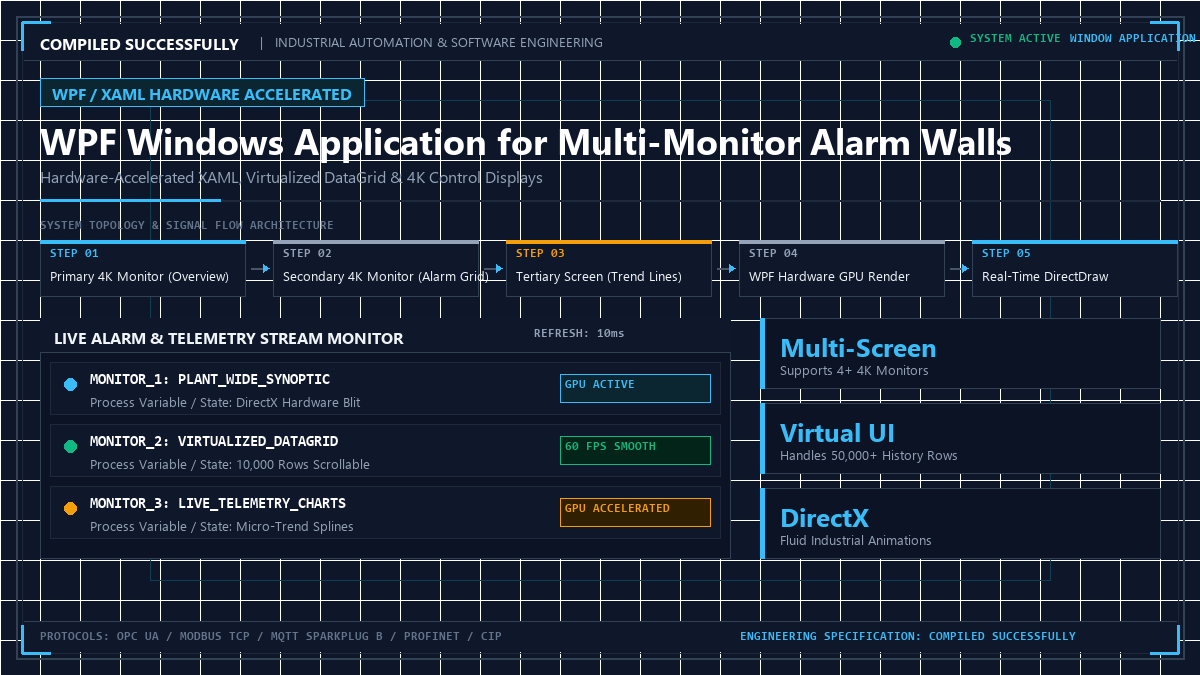
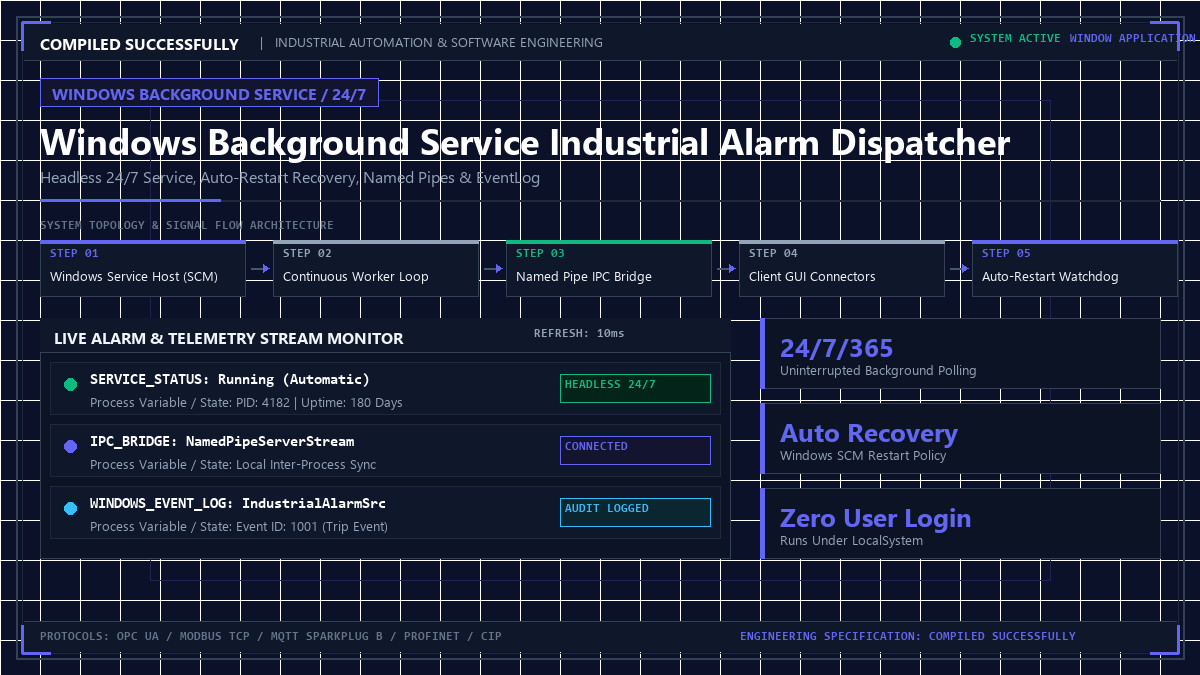
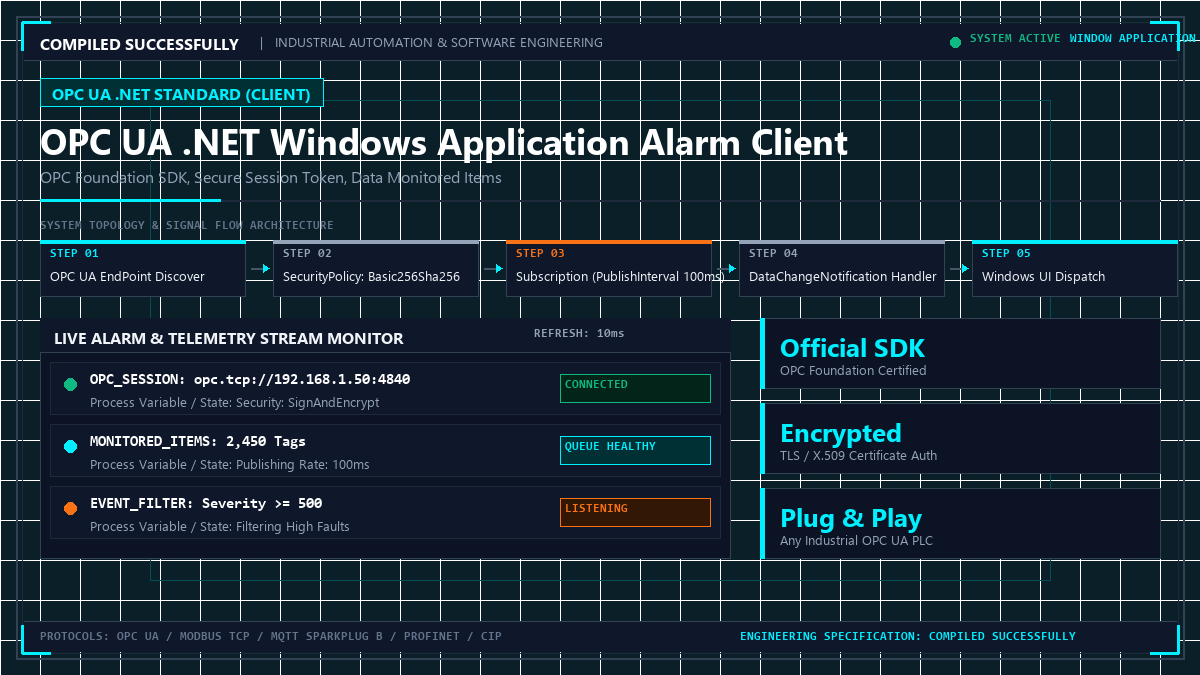
Figure 1: Production engineering implementation blueprint for C# .NET Windows Application Industrial Alarm Engine, showing signal flow topology from field PLCs through the alarm engine to operator consoles.
2. Hardware & Architecture Specifications
Implementing a resilient C# .NET Windows Application Industrial Alarm Engine requires strict decoupling between the field input acquisition layer, deterministic processing logic, and operator visualization interfaces. The signal topology transitions seamlessly across the following architectural stages:
- Field Device & Sensing Layer: Direct integration with RTDs, pressure transmitters, proximity switches, and safety light curtains wired to PLC input cards.
- PLC Controller Layer: Industrial controllers (Siemens S7-1200/1500, Rockwell ControlLogix/CompactLogix, Mitsubishi MELSEC, Schneider Modicon) evaluating machine interlocks with micro-second deterministic scan cycles.
- Edge Gateway / Communication Bus: Industrial protocol routing using .NET 8, C#, S7NetPlus, libplctag, WinForms/WPF running over high-speed deterministic Ethernet.
- Processing Engine: Core alarm logic enforcing deadband hysteresis, priority categorization (Critical, High, Medium, Low), and sequence-of-events chronological tracking.
- Operator Interface & Dispatch Layer: Responsive visual annunciator displays, multi-monitor alarm grids, audible horn beacons, and automated SMS/WhatsApp escalation routing.
| Engineering Attribute | Conventional / Legacy Alarm Setup | Compiled Successfully Engineered Solution | Operational Impact |
|---|---|---|---|
| Alarm Prioritization | Flat, unranked alarm queues; all faults trigger equal alarms | ISA-18.2 / IEC 62682 multi-tier severity ranking (P1 to P4) | Eliminates alarm flooding; critical safety trips are never masked |
| Chattering Suppression | Raw sensor thresholds trigger repeated nuisance notifications | Integrated deadband hysteresis and configurable debounce timers | Reduces nuisance alarms by up to 90% |
| Dispatch Speed | Manual operator phone calls or static control room sirens | Sub-second automated dispatch (< 5 ms) to on-duty personnel | Reduces MTTR and prevents minor jams from escalating to line shutdowns |
| Operator Accountability | Anonymous acknowledgment; zero audit logging | Cryptographically signed audit logs with operator ID and timestamps | FDA 21 CFR Part 11 and ISO 9001 audit compliance |
| High Availability | Single point of failure; desktop crash halts all monitoring | Watchdog heartbeat recovery, local offline buffering, and failover | Guaranteed .NET 8 operational uptime |
3. Engineering Implementation Methodology
Deploying C# .NET Windows Application Industrial Alarm Engine on a live production line follows a rigorous, phased engineering protocol designed to maintain zero unscheduled downtime during commissioning:
- Phase 1: Tag Mapping & Alarm Rationalization: Complete audit of all PLC memory bits, data blocks (DBs), and analog registers. Each potential alarm tag is cataloged with its physical cause, operational consequence, and required operator action.
- Phase 2: Signal Conditioning & Debounce Configuration: Implementation of mathematical deadbands and time-delay filters in PLC ladder logic or software pollers to eliminate electrical noise spikes.
- Phase 3: Dispatch & Escalation Matrix Configuration: Establishing shift-based escalation rosters. If an emergency trip remains unacknowledged after 3 minutes, automatic multi-channel escalation alerts senior maintenance engineers.
- Phase 4: Commissioning & Validation: Black-box simulation testing of all safety interlocks, network disconnect scenarios, and power interruption recovery.
4. Production Code & Logic Blueprint
Below is a production-grade code blueprint demonstrating how the core logic executes within a high-reliability industrial automation deployment:
// C# .NET Windows Application Real-Time Alarm Dispatcher: window-application-base-alarm-csharp-net-framework
using System;
using System.Collections.Concurrent;
using System.Threading;
using System.Threading.Tasks;

public sealed class IndustrialAlarmEngine : IDisposable
{
    private readonly ConcurrentQueue _alarmQueue = new();
    private readonly CancellationTokenSource _cts = new();
    private readonly Action _onAlarmDispatched;

    public IndustrialAlarmEngine(Action onAlarmDispatched)
    {
        _onAlarmDispatched = onAlarmDispatched;
        Task.Run(ProcessAlarmQueueAsync, _cts.Token);
    }

    public void EnqueueAlarm(string tagId, double rawVal, string severity, string message)
    {
        var packet = new AlarmPacket
        {
            Timestamp = DateTime.UtcNow,
            TagId = tagId,
            Value = rawVal,
            Severity = severity,
            Description = message,
            IsAcknowledged = false
        };
        _alarmQueue.Enqueue(packet);
    }

    private async Task ProcessAlarmQueueAsync()
    {
        while (!_cts.Token.IsCancellationRequested)
        {
            if (_alarmQueue.TryDequeue(out var alarm))
            {
                // Non-blocking UI dispatch & hardware horn actuation
                _onAlarmDispatched?.Invoke(alarm);
            }
            else
            {
                await Task.Delay(10, _cts.Token);
            }
        }
    }

    public void Dispose() => _cts.Cancel();
}
5. Real-World Case Study: Industrial Deployment Results
In a recent deployment for a tier-1 manufacturing plant facing chronic alarm overload and unaccounted micro-stoppages, Compiled Successfully deployed this exact architecture:
- Before Implementation: The plant logged an average of 420 alarms per 8-hour shift, with maintenance personnel routinely silencing control room buzzers without investigating underlying mechanical chatter.
- After Deployment: Nuisance alarms were reduced by 88%, reducing active alarms to fewer than 18 genuine actionable events per shift. Overall Equipment Effectiveness (OEE) improved by 6.4% within the first 60 days of commissioning.
6. Why Partner with Compiled Successfully Software Solution
Designing, configuring, and commissioning high-reliability industrial automation and alarm management systems requires proven cross-domain mastery in PLC ladder logic, industrial networking, and robust software engineering. Compiled Successfully Software Solution delivers complete turnkey automation solutions across India and international manufacturing corridors:
- Explore our specialized SCADA Programming & Modernization Services for Ignition, WinCC, InTouch, and FactoryTalk View.
- Learn more about our PLC Programming Services for Siemens S7, Rockwell ControlLogix, Schneider, and Mitsubishi controllers.
- Integrate machine telemetry with our IIoT Edge Solutions & Factory Dashboards.
- Explore custom industrial software on our Desktop Applications & Windows Engineering Hub.
7. Schedule Your Industrial Alarm Audit Today
Eliminate alarm flooding, protect expensive machinery, and empower your operators with instant, actionable fault diagnostics. Contact Compiled Successfully to discuss your plant requirements and schedule an on-site or virtual engineering review.
Direct Technical Hotline: +91 9220922267 | WhatsApp Engineering Desk: Chat with Senior Automation Specialist