1. The Overlooked Link: Industrial Control Systems and Energy Consumption
In heavy manufacturing, energy costs represent one of the largest single operating expenses alongside raw materials and labor. When corporate sustainability teams seek to lower kilowatt-hour (kWh) consumption and reduce carbon intensity, they typically look at replacing fluorescent lighting with LEDs or upgrading compressor air lines.
Rarely does executive management realize that obsolete legacy PLCs are responsible for massive electrical energy waste across production floors. Inefficient motion profiling, sluggish PID calculation loops, lack of synchronized VFD control, and inability to track power factors result in significant preventable power losses.
Energy Reduction Metrics Achievable via Modern Controls
- Average Electrical Energy Savings: Plants that replace legacy PLCs and integrate coordinated drive control achieve an overall 12% to 22% reduction in machine kWh consumption.
- Peak Demand Shaving: Modern PACs execute automated load-shedding and staggered motor startup sequences that slash industrial utility peak demand surcharges by 18% to 35%.
- Compressed Air Waste Mitigation: Automated pneumatic shut-off routines executed during line pauses eliminate 30% of compressed air leakage waste.
- Thermal Loop Precision: High-speed temperature PID autotuning on modern controllers reduces industrial heating furnace electric draw by 8% to 14%.

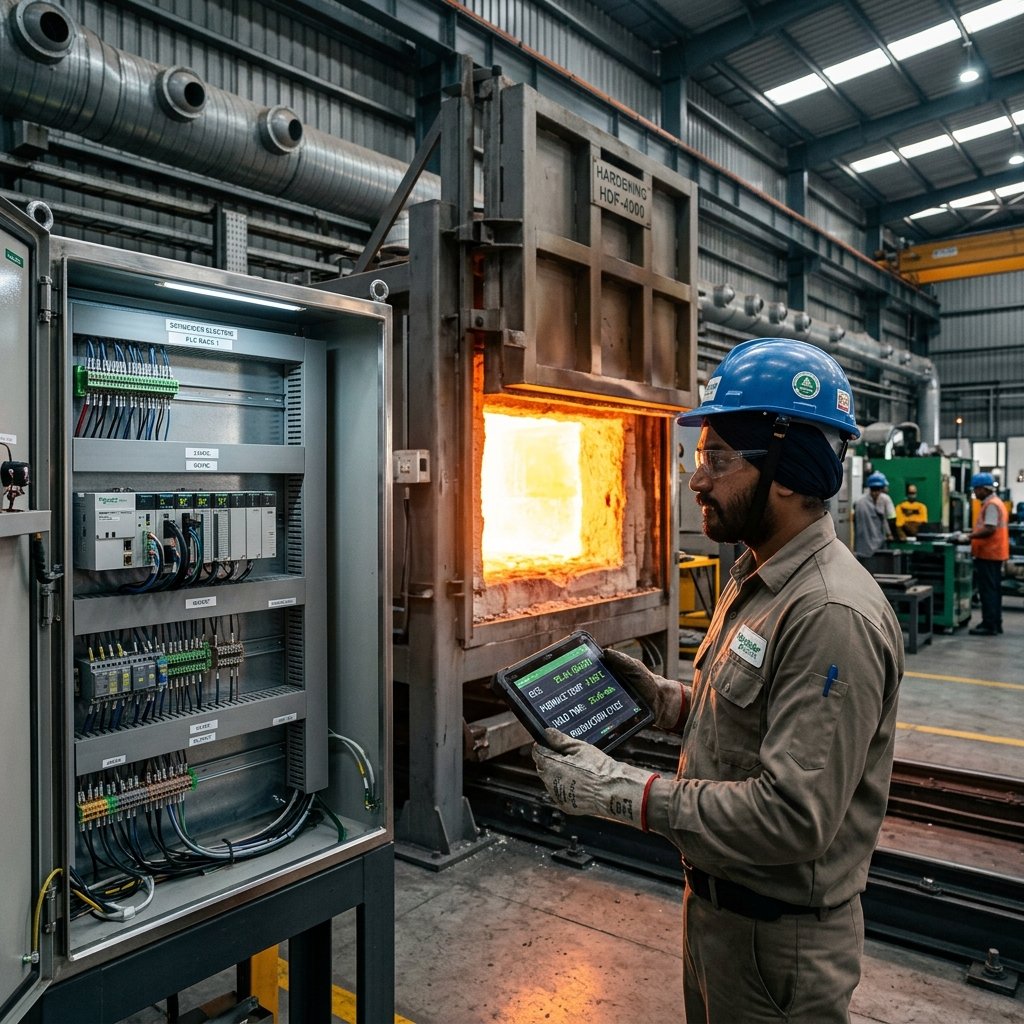
Figure: Real-world engineering implementation showing Smart PAC-integrated energy monitoring console executing peak demand shaving and coordinated VFD power optimization.
2. How Modern PACs Reduce Electrical Consumption
| Energy Control Mechanism | Legacy Obsolete PLC Limitation | Modern Industrial PAC Optimization | Average Energy Savings |
|---|---|---|---|
| Drive Coordination | Discrete digital/analog speed setpoints (0-10V) with jitter | High-speed deterministic Ethernet (Profinet IRT / CIP Motion) | 8% – 15% Drive Efficiency Gain |
| Idle State Management | Motors and conveyors run continuously during line pauses | Automated smart sleep/standby mode with instant wake-up | 14% – 25% Idle Power Reduction |
| Peak Demand Staggering | Manual simultaneous startup causes massive inrush spikes | Algorithmic staggered motor sequencing based on grid tariffs | 20% – 35% Peak Tariff Surcharge Cut |
| Native Power Metering | Zero energy visibility; reliance on monthly utility bill | Direct Modbus TCP / Profinet energy meter integration | Real-Time Specific Energy Consumption (SEC) |
3. Mathematical Optimization: Sub-Millisecond Motion Profiling
Legacy PLCs executing analog speed references introduce 25ms to 50ms of communication latency. When multiple conveyors or multi-axis mechanical linkages run asynchronously, motors fight against mechanical binding, wasting electrical energy as mechanical friction and heat. Modern PACs synchronize multi-axis motion over gigabit industrial Ethernet with sub-microsecond jitter, ensuring optimal torque delivery with minimum electrical draw.
4. Integrating Smart Energy Monitoring into Modernized Panels
When Compiled Successfully retrofits a legacy PLC cabinet, our engineering panel incorporates native digital energy transducers (such as Schneider PowerLogic or Siemens PAC3200 meters) directly into the new controller backplane. This provides plant managers with real-time Specific Energy Consumption (kWh per unit produced) tracked on live SCADA dashboards.
5. Partner with Compiled Successfully for Energy-Efficient Automation
Modernize your control systems and lower utility bills with Compiled Successfully:
- Explore our specialized PLC Engineering & Modernization Services.
- Track live energy telemetry via our SCADA Dashboard Solutions.
- Deploy factory-wide power monitoring with our IIoT Energy Management Systems.
6. Request an Industrial Energy & Controls Audit
Contact Compiled Successfully to quantify the energy savings achievable by modernizing your factory's aging controllers.
Hotline: +91 9220922267 | WhatsApp: Schedule Energy Automation Review