1. Introduction: The Urgent Mandate to Replace Allen-Bradley PLC-5 Systems
First introduced by Rockwell Automation in 1986, the Allen-Bradley PLC-5 controller family (including the legendary 1785-L20B, L40B, and L80E processors) served as the resilient backbone of industrial manufacturing for over three decades. However, Rockwell announced the official Discontinued (End-of-Life) status for the entire PLC-5 product line in June 2017. Today, operating a plant reliant on aging PLC-5 hardware is no longer a badge of equipment longevity—it is an existential operational hazard.
Modern manufacturing plants across automotive stamping, steel processing, paper mills, and continuous chemical production face escalating maintenance crises. Replacement processors and analog cards are obtainable only through secondary grey-market brokers at exorbitant premiums, while experienced PLC-5 ladder logic programmers retire in record numbers.
Critical Industrial Statistics: The Cost of Inaction
- Downtime Cost: According to the Aberdeen Group, unplanned downtime in heavy manufacturing averages $260,000 per hour (and exceeds $22,000 per minute on high-speed automotive assembly lines).
- Component Failure Rates: Legacy power supplies (1771-P4S, 1771-P7) and processor backplanes older than 20 years exhibit a 3.8x higher annual failure rate due to electrolytic capacitor dry-out and solder joint fatigue.
- Grey-Market Spare Inflation: Sourcing a refurbished 1785-L80B processor now carries a 450% to 700% price premium compared to original catalog prices, accompanied by unverified operational histories.
- MTTR Penalty: Mean Time to Repair (MTTR) on legacy PLC-5 racks averages 4.6 hours vs. just 22 minutes on modern tag-based ControlLogix architectures equipped with onboard web diagnostics.

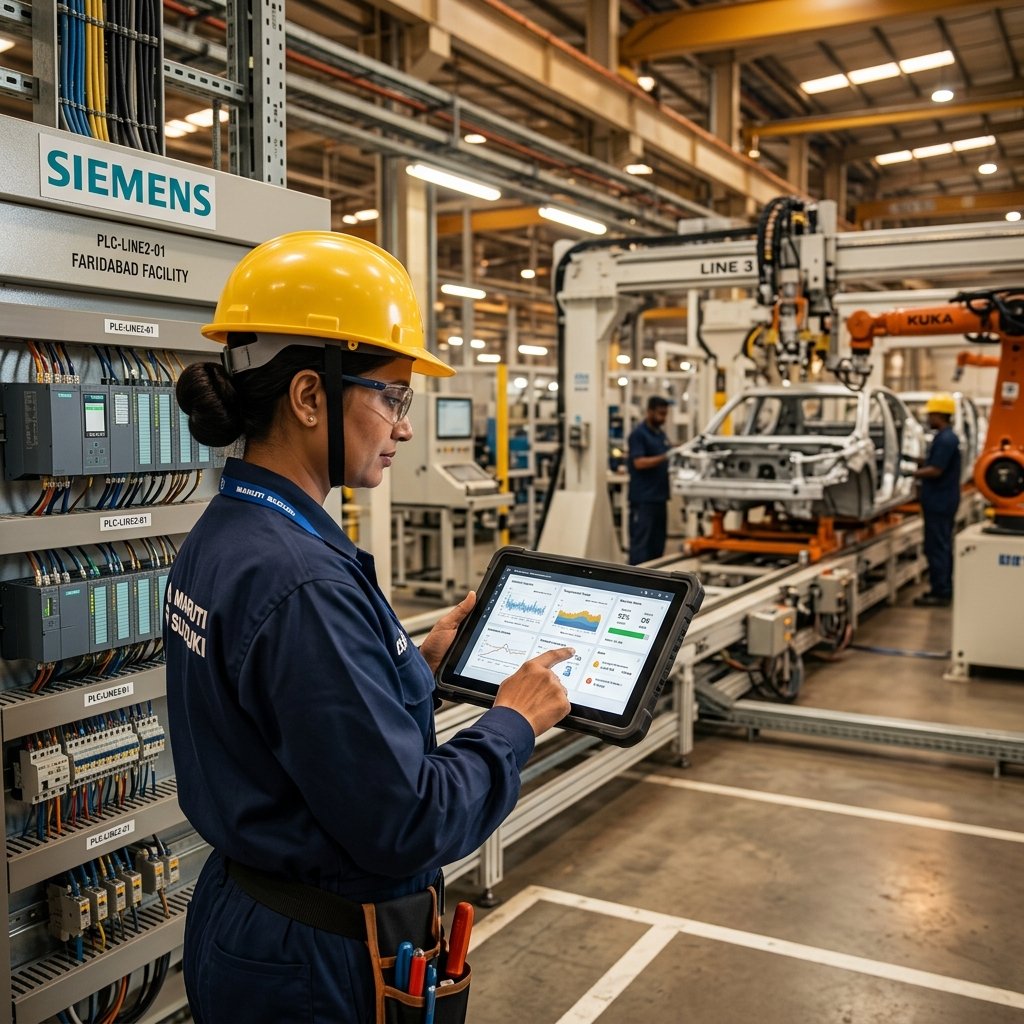
Figure: Real-world engineering implementation showing Allen-Bradley ControlLogix PAC migration with 1771 swing-arm conversion wiring and EtherNet/IP architecture.
2. Hardware & Architecture Comparison: PLC-5 vs. ControlLogix 5580
Upgrading from PLC-5 to Rockwell's flagship ControlLogix 5580 (1756 series) delivers orders-of-magnitude improvements across processing speed, memory, communication bandwidth, and diagnostic depth:
| Engineering Attribute | Legacy Allen-Bradley PLC-5 | Modern ControlLogix 5580 (1756) | Operational Impact |
|---|---|---|---|
| Processor Architecture | 16-bit proprietary microprocessor (8 to 16 MHz) | 1 GHz multi-core 32/64-bit industrial processor | Scan times plummet from 25–45ms down to 0.4–1.2ms |
| Memory Structure | Fixed data tables (N7, B3, T4, C5, F8, etc.) up to 100k words | Dynamic tag-based memory up to 40 MB with User-Defined Data Types (UDTs) | Eliminates cryptic address mapping; enables self-documenting code |
| Network Communications | Data Highway Plus (DH+), Remote I/O (RIO) @ 57.6 kbps | Gigabit EtherNet/IP (1 Gbps) with native dual-port ring (DLR) | 17,000x faster bandwidth; seamless SCADA, MES, and IIoT integration |
| I/O Wiring Migration | Bulky 1771 chassis with screw-terminal swing arms | 1492 I/O Wiring Conversion System (Drop-in swing-arm adapters) | Zero field rewiring required; retains existing cabinet wiring |
| Cybersecurity (ISA/IEC 62443) | Zero authentication; plaintext cleartext comms; no audit trail | FactoryTalk Security, encrypted firmware, role-based user access | Immune to unauthorized tampering and rogue network packet injections |
3. Key Failure Modes of Aging PLC-5 Hardware
Plant engineers seeking to justify PLC replacement to executive management must articulate the physical failure mechanisms inherent in 25+ year-old hardware:
- Electrolytic Capacitor Degradation: The filter capacitors inside 1771-P4 and 1771-P7 power supplies suffer from electrolyte evaporation governed by the Arrhenius rate law. A continuous 10°C increase in internal control cabinet ambient temperature cuts capacitor operating lifespan in half, causing catastrophic ripple voltage spikes that destroy backplane modules.
- Backplane Optocoupler Wear-Out: Optical isolators on 1771-IBD (digital input) and 1771-OAD (digital output) modules lose infrared LED photon emission efficiency over time, causing intermittent "ghost inputs" and mysterious line dropouts that evade traditional multimeter testing.
- Battery Failure & RAM Amnesia: PLC-5 memory preservation relies on 3.0V lithium batteries (1770-XYC). If a battery drains during a scheduled plant weekend shutdown, the controller suffers catastrophic memory loss, requiring obsolete DOS-based 6200 software or RSLogix 5 running on fragile Windows XP virtual machines to reload memory dumps.
4. The Zero-Downtime Migration Methodology: Rockwell 1492 Conversion System
The single greatest obstacle to replacing old PLC systems is the fear of extended downtime while rewiring thousands of field I/O terminations. Fortunately, engineering best practices utilize the Rockwell Automation 1492 Wiring Conversion System:
- Chassis Dimension Parity: The 1492 conversion mounting plate matches the exact footprint and mounting bolt holes of the original 1771-A1B, A2B, A3B, or A4B chassis. No drilling or backpanel fabrication is needed.
- Swing-Arm Retention: The existing 1771 field wiring arms (with wires intact) are unplugged from the PLC-5 modules and locked directly into 1492 conversion terminal bases.
- Pre-Molded Cable Assemblies: Factory-tested multi-conductor cables link the 1492 conversion bases directly to modern 1756-IB16, 1756-OB16, 1756-IF8, and 1756-OF8 modules mounted in the new ControlLogix chassis.
- Cutover Efficiency: This conversion cuts cabinet installation time from 72 hours down to less than 8 hours, allowing complete cutover over a standard weekend maintenance window.
5. Software Translation: RSLogix 5 to Studio 5000 Logix Designer
Modernizing the software involves converting legacy octal-addressed file systems to modern tag-based structures:
- Rockwell Migration Assistant: Rockwell's translation utility ingests RSLogix 5
.RSPexport files (.PC5) and maps fixed data tables (e.g.,N7:0becomesN7[0]). - Refactoring Spaghetti Logic: Professional automation engineering requires refactoring unconditional jumps (
JMP/LBL) and bit-masked status words into structured subroutines and modern Add-On Instructions (AOIs). - Network Bridges during Phased Cutover: Utilizing 1756-DHRIO or ProSoft AN-X2-AB-DHRIO gateway modules permits the new ControlLogix processor to control remote 1771-ASB RIO racks while individual machine sections are incrementally upgraded.
6. Why Partner with Compiled Successfully for PLC Modernization
Replacing an Allen-Bradley PLC-5 system demands deep domain expertise in both vintage control paradigms and modern high-speed industrial networks. Compiled Successfully Software Solution offers complete turnkey PLC retrofit services across India and global installations:
- Explore our specialized PLC Programming Services for Rockwell, Siemens, Schneider, and Mitsubishi controllers.
- Discover our full suite of SCADA Programming & Modernization for FactoryTalk View, Ignition, and Wonderware.
- Connect your modernized PLC to plant-wide analytics with our IIoT Edge Solutions & Dashboards.
7. Conclusion: Schedule Your Legacy PLC Engineering Audit Today
Do not wait for a burnt backplane or exhausted lithium battery to force an emergency plant shutdown. Contact Compiled Successfully to execute a planned, phased, and risk-free PLC-5 to ControlLogix migration.
Direct Hotline: +91 9220922267 | WhatsApp: Chat with Senior Automation Specialist