1. The Legacy Software Debt: The Peril of 1980s Spaghetti Logic
When industrial plants evaluate PLC replacements, engineering attention naturally focuses on physical hardware: racks, power supplies, and wiring. However, the greatest long-term liability often resides in the software logic. Over 20 to 30 years of continuous factory operations, original ladder logic programs accumulate severe technical debt.
Dozens of different maintenance technicians add temporary rungs, bypasses, unconditional jumps (JMP/LBL), and hard-coded memory offsets. Variable names are absent or truncated to 6-character acronyms. When this unorganized "spaghetti code" is simply imported as-is into a modern controller, the plant inherits all legacy bugs, unreadable structures, and diagnostic blind spots.
Software Modernization Metrics
- Logic Troubleshooting Speed: Refactoring legacy ladder into standardized IEC 61131-3 Function Blocks cuts software troubleshooting time by 65%.
- Code Footprint Reduction: Leveraging User-Defined Data Types (UDTs) and reusable Add-On Instructions (AOIs) reduces total project rung count by 40% to 55%.
- Future Engineering Maintenance: IEC 61131-3 standardized code enables new automation engineers to understand machine sequencing within hours rather than weeks.

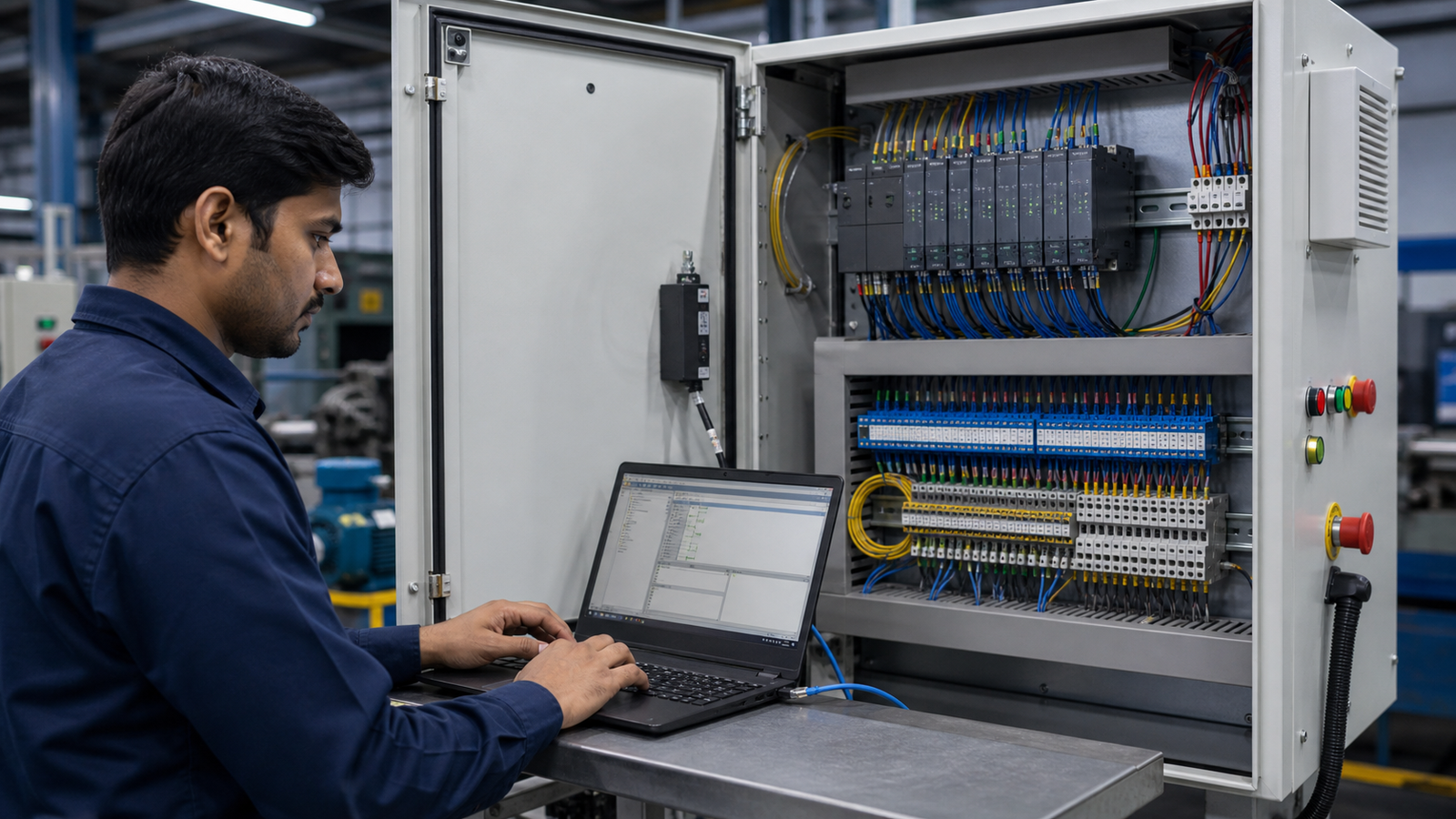
Figure: Real-world engineering implementation showing Modern PAC programming workstation refactoring legacy octal ladder logic into modular IEC 61131-3 Function Blocks and UDTs.
2. Legacy Programming vs. Modern IEC 61131-3 Standard
| Software Attribute | Legacy Programming Paradigm | Modern IEC 61131-3 Paradigm | Engineering Advantage |
|---|---|---|---|
| Memory Addressing | Fixed octal or decimal registers (N7:12, DB10.DBW4) |
Descriptive symbolic tags (Conveyor_Speed_Setpoint) |
Self-documenting logic; eliminates cryptic memory mapping errors |
| Complex Math & Loops | Clunky ladder rungs with multiple CPT, MUL, DIV boxes |
Structured Text (ST / SCL) mathematical expressions | Compact, readable mathematical algorithms and array sorting |
| Repetitive Logic | Copied-and-pasted rungs with manual address increments | Reusable Function Blocks (FB) and Add-On Instructions (AOI) | Modify code in one central block; updates all machine instances instantly |
| Machine State Flow | Scattered latch/unlatch bits (OTL/OTU) prone to race conditions |
Sequential Function Chart (SFC) or PackML State Model | Deterministic, safe machine state progression with clear fault states |
3. The 4-Step Code Refactoring Framework
At Compiled Successfully, our automation team executes systematic software modernization:
- Code Audit & Dead-Logic Purging: Scan the legacy program to identify unreferenced bits, commented-out test rungs, and abandoned timers. Remove dead code before translation.
- Data Model Transformation (UDTs): Create structured data models representing physical machine components (e.g., creating a
VFD_Drive_UDTcontainingRun_Command,Speed_Feedback,Current_Amps, andFault_Code). - Algorithm Segregation: Retain visual Ladder Diagram (LD) for interlocks, limit switches, and safety sequences where electricians need visual troubleshooting; move complex data manipulation, recipe math, and string parsing to Structured Text (ST).
- Standardized Alarming (ISA-18.2): Replace scattered bit-alarms with standardized alarm blocks containing priority levels, debounce timers, and time-stamped first-fault capture.
4. Transforming Code for Industry 4.0 Readiness
Once code is refactored into clean IEC 61131-3 structures, streaming machine states to SCADA, MES, and cloud databases becomes effortless. Modern tags map directly to OPC UA nodes and MQTT Sparkplug B payloads without complex middleware.
5. Partner with Compiled Successfully for Logic Modernization
Compiled Successfully transforms legacy codebases into robust, high-performance automation software:
- Explore our specialized PLC Programming & Logic Refactoring Services.
- Upgrade your HMI screens via our SCADA Migration Services.
- Connect your modernized PLC to plant dashboards via our IIoT Edge Gateway Solutions.
6. Request a Free Code Audit
Send our senior engineering panel your legacy PLC program file for a comprehensive refactoring and modernization assessment.
Hotline: +91 9220922267 | WhatsApp: Submit Code for Audit