1. The Troubleshooting Crisis on Legacy Automated Machinery
In manufacturing maintenance, the efficiency of an engineering department is measured by two core metrics: Mean Time Between Failures (MTBF) and Mean Time to Repair (MTTR). While component quality determines MTBF, the diagnostic accessibility of your industrial control system dictates MTTR.
When an automated production line stops unexpectedly, every passing minute incurs severe financial losses. On machines controlled by 20-year-old legacy PLCs, maintenance teams spend 85% of their total outage time simply identifying what stopped the machine, and only 15% actually replacing the faulty sensor or resetting the mechanical jam.
MTTR Benchmarks: Legacy PLC vs Modern PAC
- Average MTTR on Legacy PLCs: Electrical troubleshooting on obsolete controllers (PLC-5, SLC 500, S5) averages 4.2 to 5.6 hours per incident.
- Average MTTR on Modern PACs: Troubleshooting identical machine faults on modern controllers (ControlLogix 5580, S7-1500) averages 18 to 28 minutes.
- Overall MTTR Reduction: Modernizing the control system achieves a verified 70% to 85% reduction in total repair time.
- Annual Downtime Savings: In a facility experiencing 15 minor electrical stoppages per year, slashing MTTR saves over 60 hours of lost production capacity.

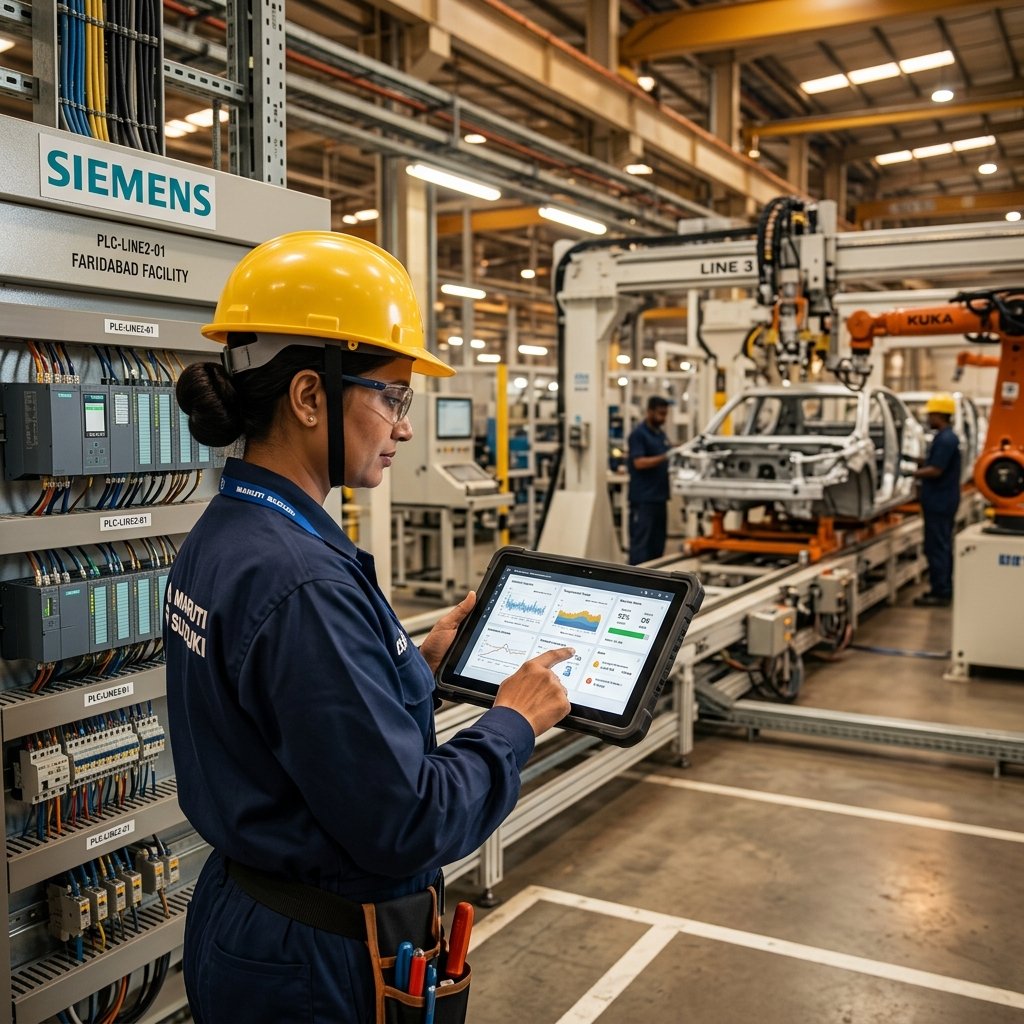
Figure: Real-world engineering implementation showing Diagnostic troubleshooting interface providing plain-text fault descriptions and slashing MTTR from 4.2 hours to 22 minutes.
2. Why Troubleshooting Legacy PLCs Takes Hours
The sluggish MTTR of older controllers is driven by structural technological limitations:
- Lack of Plain-Language Diagnostics: Older controllers indicate problems via a single blinking red "FAULT" LED. To understand the error, an engineer must locate a legacy programming console, connect via RS-232, and look up raw hexadecimal status codes (e.g.,
Major Fault 003Ah) in printed paper manuals. - Disconnected Tag Databases: In legacy systems (such as SLC 500 or Simatic S5), comments and symbol names were stored exclusively on the programmer's laptop, not on the controller. If the plant lacks the exact original offline project file, an engineer sees only raw addresses (e.g.,
I:2/4orE 4.2) with zero descriptions. - Absence of First-Fault Capture: When an emergency stop chain trips, ten interlocks may drop simultaneously. Legacy PLCs lack millisecond-precision event buffers, forcing technicians to guess which safety switch opened first.
3. Diagnostic Capabilities of Modern PAC Architectures
| Diagnostic Feature | Legacy Obsolete PLC Reality | Modern Industrial PAC Architecture | MTTR Impact |
|---|---|---|---|
| Onboard Controller Display | Basic red/green status LEDs only | High-resolution graphical color screen with plain-text fault text | Instant diagnosis at cabinet door without opening PC |
| Embedded Web Server | None; requires proprietary programming software | Native HTML5 web server accessible via standard mobile browser | Any technician reads live diagnostics via tablet or smartphone |
| First-Fault Event Buffering | Scattered rungs; no sub-millisecond latching | Integrated Sequence of Events (SOE) with microsecond timestamps | Pinpoints exact root-cause interlock with zero ambiguity |
| Channel-Level I/O Diagnostics | Blown fuse LED on physical module only | Electronic per-channel open-wire, short-circuit, and overload tags | Identifies exact field wire problem directly in SCADA/HMI |
4. Turning Maintenance Teams into High-Efficiency Responders
When Compiled Successfully executes a control modernization project, we configure automated first-fault detection routines, pre-built HMI alarm banners, and optional SMS/WhatsApp notifications. When a fault occurs, the maintenance supervisor receives a push alert indicating: "Press 3 Hydraulic Pump Overload: Check thermal relay 42M2 in Panel B."
5. Partner with Compiled Successfully
Slash your facility's MTTR with engineered automation solutions:
- Explore our specialized Turnkey PLC Replacement Services.
- Upgrade your operator alarm displays via our SCADA Programming Services.
- Implement automated downtime tracking with our IIoT Machine Monitoring Solutions.
6. Request an MTTR Optimization Audit
Contact Compiled Successfully to analyze your plant's current downtime response times and evaluate modern diagnostic retrofits.
Hotline: +91 9220922267 | WhatsApp: Connect with an MTTR Specialist