1. The High-Stakes Automotive Arena: When Every Minute Costs $22,000
In modern automotive manufacturing—spanning body-in-white (BIW) robotic welding cells, paint shop conveyors, engine sub-assembly skids, and final vehicle trim lines—production cadence is measured in seconds. A typical automotive Tier-1 or OEM assembly facility operates with a target Takt time between 45 and 90 seconds per vehicle.
When an obsolete 20-year-old PLC (such as an Allen-Bradley PLC-5/80 or Siemens S5-155U) trips due to an internal backplane fault or communication timeout, the entire assembly line comes to an abrupt halt. With downtime costs exceeding $22,000 to $50,000 per minute, an unpredicted 2-hour controller failure can erase an entire shift's profit margin.
Automotive Control Modernization Metrics
- Financial Outage Penalty: Automotive line downtime averages $1.3 Million per hour in lost vehicle build slots and supplier expedited freight penalties.
- Cycle-Time Improvement: Upgrading from legacy 40ms scan times to sub-millisecond PAC controllers reduces robotic cell indexing delays by 1.8 to 3.2 seconds per cycle.
- Safety Integration Efficiency: Transitioning to integrated Safety PLCs (SIL 3 / PLe) eliminates up to 60% of hardwired safety relays inside welding cell panels.

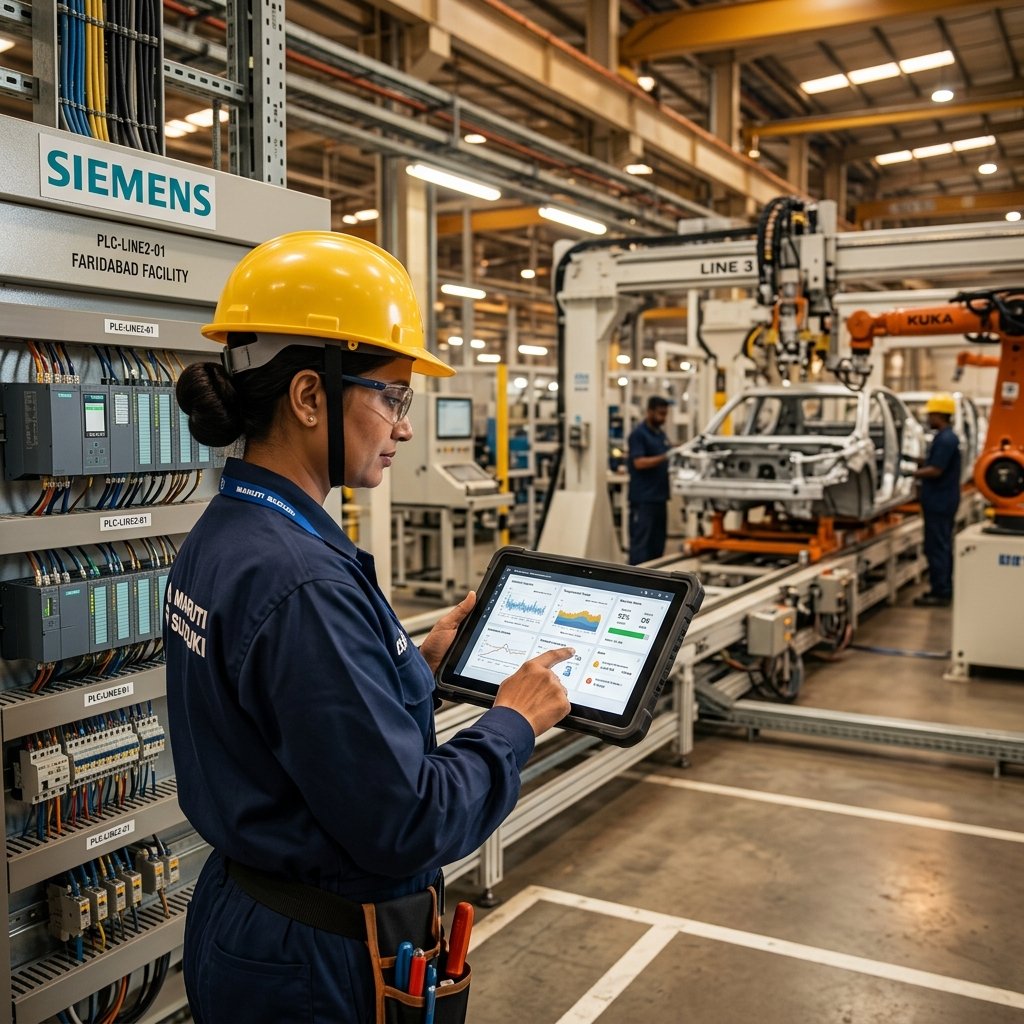
Figure: Real-world engineering implementation showing Automotive Body-in-White (BIW) robotic welding line retrofitted with sub-millisecond interlocking and integrated SIL 3 safety PAC.
2. Technical Demands of Automotive Control Modernization
| Automotive Cell Component | Legacy Obsolete Control Limitation | Modernized PAC / PLC Architecture | Production Impact |
|---|---|---|---|
| Robotic Cell Interlocking | Slow discrete 24VDC handshakes across serial networks (RIO / DeviceNet) | Deterministic Ethernet (Profinet IRT / CIP Safety) | Eliminates interlock hesitation; instant robot motion clearance |
| Spot & Laser Welding Controls | Separate stand-alone weld timers with manual quality logging | Integrated weld controller Ethernet feedback with live current curves | 100% weld nugget traceability; prevents defective unbonded seams |
| Conveyor & AGV Routing | RFID readers wired via complex serial converters | Direct IO-Link and Industrial Ethernet RFID tracking | Zero vehicle tracking errors; automated variant body routing |
| Machine Safety & Light Curtains | Massive banks of hardwired safety relays; difficult to troubleshoot | Integrated GuardLogix / S7-1500F safety network over single Ethernet cable | Safe zones configured in software; zone-specific muting during loading |
3. Step-by-Step Automotive Cutover Strategy: The Model Changeover Window
Automotive facilities rarely grant multi-day shutdowns outside scheduled annual model changeover or holiday retooling periods. Our engineering team utilizes a Pre-Commissioned Cell Skid Methodology:
- Digital Twin Cell Emulation: The robotic welding cell kinematics and PLC logic are modeled in virtual commissioning software, validating all robot entry interlocks.
- Swing-Arm Conversion: Existing 1771 or S5 wiring arms are transferred into conversion sockets during a 12-hour Saturday shutdown.
- Dry-Cycle Robot Handshake Verification: Robots execute weld paths without live welding to verify clearance envelopes and safety laser scanner zones.
- Production Ramp-Up: The cell resumes full automotive production on Sunday evening with on-site shadow engineering support.
4. Compiled Successfully Automotive Capabilities
Compiled Successfully provides turnkey automation retrofits for Tier-1 suppliers and automotive OEMs:
- Discover our specialized Automotive PLC Programming Services.
- Upgrade your line HMI and SCADA displays via our SCADA Migration Services.
- Track real-time OEE and station cycle times with our IIoT Smart Factory Solutions.
5. Request an Automotive Plant Audit
Modernize your automotive robotic and assembly controls with zero production interruption. Contact Compiled Successfully today.
Hotline: +91 9220922267 | WhatsApp: Connect with an Automotive Automation Lead