1. The End of an Era: The Looming Crisis of Obsolete SLC 500 Controllers
The Allen-Bradley SLC 500 series (including SLC 5/01, 5/02, 5/03, 5/04, and 5/05 processors housed in 1746 chassis) dominated mid-tier manufacturing applications for over 25 years. Tens of thousands of packaging lines, water treatment skids, CNC machining centers, and material handling systems still run on these workhorse controllers. However, Rockwell officially placed the entire SLC 500 family in Silver Series (Discontinued) status between 2014 and 2018.
Plants running SLC 500 hardware face severe supply chain vulnerabilities. A single blown 1746-OA16 triac output card or damaged 1747-L552 processor can shut down an entire manufacturing facility for days while maintenance scrambles to source uncertified surplus components on the internet.
SLC 500 Obsolescence by the Numbers
- Average Age of Operating Units: The median installed SLC 500 controller has been operating for 18.4 years, well past its designated 10-year mean time between component degradation.
- Downtime Penalty: The average cost of an unpredicted packaging line stoppage driven by legacy PLC faults ranges from $35,000 to $95,000 per incident.
- Spare Parts Availability: Over 74% of 1746 analog I/O modules available online are refurbished units with degraded internal optocouplers and dried solder joints.
- Diagnostic Latency: Resolving a machine fault on SLC 500 requires connecting via legacy RS-232 serial cables or DH-485 interfaces, which modern laptops no longer support without fragile USB converters.

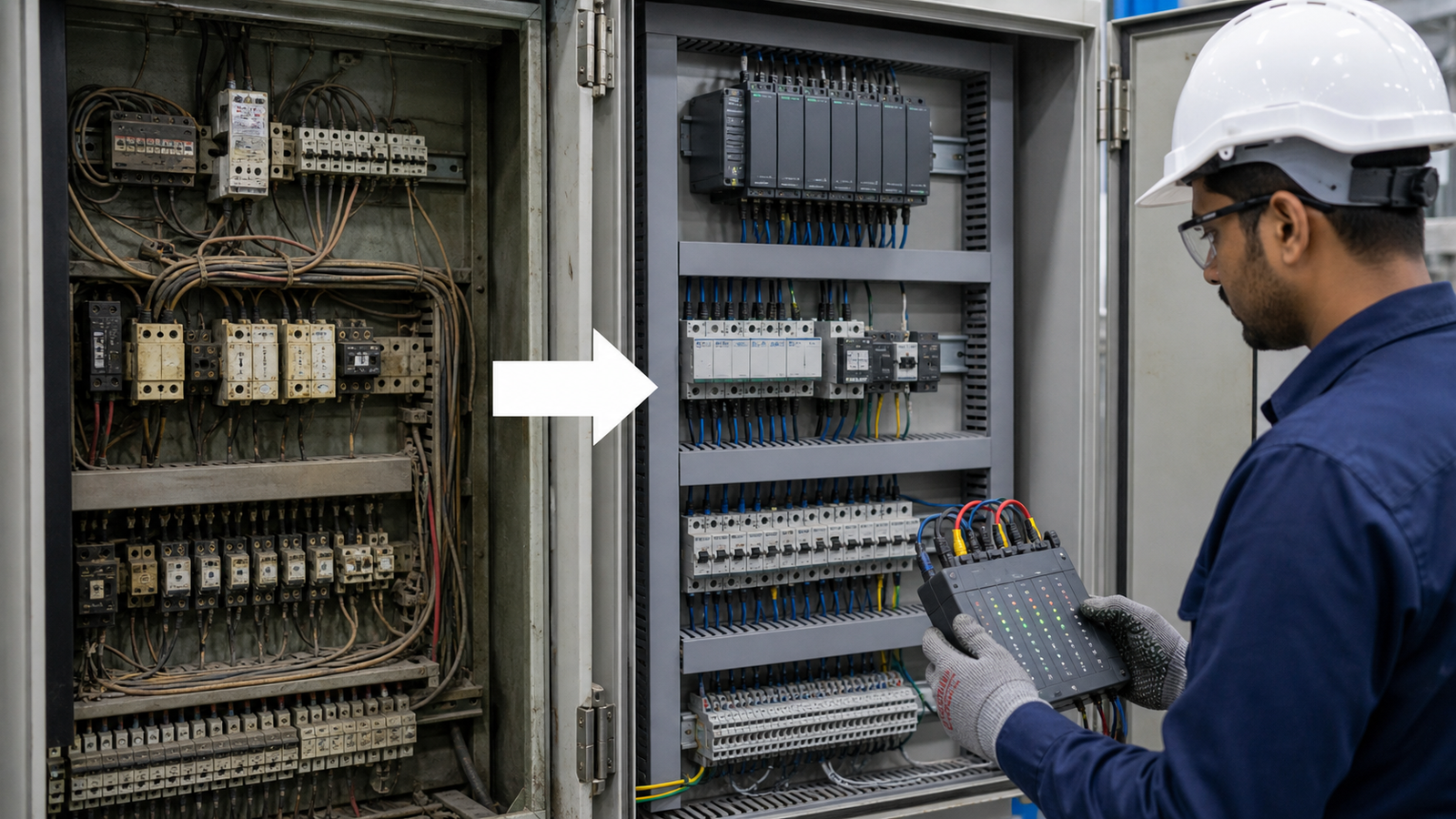
Figure: Real-world engineering implementation showing CompactLogix 5380 controller panel upgrade with 1492 pre-wired conversion modules replacing legacy 1746 racks.
2. Hardware Transformation: SLC 500 vs CompactLogix 5380
The designated migration target for SLC 500 is Rockwell's high-performance CompactLogix 5380 (5069 series) or CompactLogix 5370 (1769 series):
| Feature / Specification | Obsolete SLC 500 (1746/1747) | Modern CompactLogix 5380 (5069) | Plant Performance Benefit |
|---|---|---|---|
| Processor Architecture | 16-bit CISC microprocessor | Multi-core ARM Cortex high-speed processor | Up to 20x faster logic execution and sub-millisecond motion sync |
| Addressing Model | Fixed register files (O0, I1, S2, B3, T4, C5, R6, N7, F8) | Descriptive Tag-Based Memory with Structures | Clear, human-readable logic eliminates address lookup errors |
| Communication Ports | DH-485, DH+, RS-232 (19.2 kbps), 10 Mbps Ethernet (5/05) | Dual 1-Gigabit Ethernet ports with DLR & separate IP modes | Enterprise IT/OT integration, OPC UA, and SCADA cloud connectivity |
| Wiring Conversion | 1746 screw-terminal removable blocks | Rockwell 1492-CS500 Wiring Conversion System | Converts existing 1746 wiring arms to 5069 I/O in minutes |
| Safety Integration | Separate hardwired safety relays and interlocks | Integrated Compact GuardLogix (SIL 3 / PLe) | Eliminates external safety relays; simplifies safety compliance |
3. Eliminating the Field Rewiring Nightmare: 1492 Conversion System
The greatest risk in retrofitting legacy SLC 500 racks is miswiring field connections. A 10-slot 1746 chassis typically houses over 160 digital and analog wire terminations. Tracing, labeling, stripping, and landing these wires manually consumes 30 to 45 hours of electrician labor and introduces a 15% probability of wiring errors during initial power-up.
With the Rockwell 1492-CS500 conversion kit:
- The existing 1746 terminal block with field wiring intact is unclipped from the obsolete I/O module.
- The terminal block snaps directly into a 1492 conversion adapter module mounted on a specialized DIN-rail conversion bracket.
- A prefabricated, color-coded multi-conductor cable assembly plugs from the 1492 adapter directly into the new 5069 Compact I/O terminal base.
- Total physical cutover time is reduced from days to under 4 hours per panel.
4. Step-by-Step Software Conversion Process
Migrating from RSLogix 500 to Studio 5000 Logix Designer requires systematic logic refactoring:
- Save As .ACH: Export the RSLogix 500 project file to an ASCII translation file (
.ACH) to preserve symbol databases and rung comments. - Rockwell Project Migrator: Ingest the archive into Rockwell's translation utility, which maps files to tag arrays (e.g.,
B3:0/5becomesB3[0].5). - Refactor Obsolete Instructions: Instructions such as
COP(Copy File),BSL(Bit Shift Left), andSQO(Sequencer Output) must be audited and converted to modern Array instructions or Add-On Instructions. - HMI Tag Remapping: Update PanelView Standard or PanelView Plus terminals to communication drivers pointing directly to the new CompactLogix controller tags.
5. Compiled Successfully Turnkey SLC 500 Replacement Services
Compiled Successfully provides complete engineering execution for SLC 500 and MicroLogix retrofits across industrial zones:
- Learn more about our PLC Programming Services.
- Modernize your factory visualization with our SCADA & HMI Upgrades.
- Implement real-time equipment telemetry through our IIoT Smart Factory Solutions.
6. Take the Next Step
Upgrade before your aging SLC 500 power supply fails during peak production. Contact our engineering team for an on-site evaluation.
Direct Helpline: +91 9220922267 | WhatsApp: Connect with an Automation Engineer