Chat on WhatsApp
Three-Tier Automation Architecture Cluster A — SAP / ERP ↔ PLC / Shop-Floor Integration

ERP SCADA PLC Integration

Compiled Successfully Software Solution designs robust three-tier integration architectures connecting enterprise ERP systems with supervisory SCADA nodes and machine-level PLCs. Balance centralized production scheduling with real-time supervisory control and deterministic field execution.
Zero Manual Intervention Multi-Brand PLC Support Sub-Second Latency
Cluster A — SAP / ERP ↔ PLC / Shop-Floor Integration
LIVE OT STREAM
ERP SCADA PLC Three-Tier Architecture Diagram
< 1.2 ms
Handshake
100%
Zero Data Loss
Multi-PLC
Compatible
The Industrial Challenge

The Architectural Dilemma: Direct Controller Links vs Supervisory Coordination

Manufacturing plants operating complex process or discrete production lines frequently struggle with integration topology. Bypassing SCADA to connect ERP directly to PLCs can blind control room operators to incoming orders, while relying solely on SCADA without PLC validation can introduce latency and miss high-speed sensor trips.

Why Traditional Methods Fail:

Without an integrated three-tier architecture, data silos emerge between the control room (SCADA), the machine panel (HMI/PLC), and the executive office (ERP), leading to desynchronized recipes, conflicting commands, and uncoordinated emergency stops.

Critical Pain Points Solved

  • Control room operators unaware of active ERP order priorities running on field machines
  • Supervisors manually re-typing order setpoints from paper reports into SCADA terminals
  • Inability to correlate lower-level PLC drive alarms with supervisory SCADA mimic displays and ERP order logs
  • Lack of a unified data pipeline that scales across multi-machine production bays

Technical Bottlenecks in Heterogeneous Automation

Complex production lines (e.g., continuous rolling mills, paint shops, bottling plants) require coordinated interlocking across dozens of PLCs. An uncoordinated integration approach causes line jams and inconsistent batch records.

System Architecture

Coordinated Architecture: ERP ↔ Integration Layer ↔ SCADA ↔ PLC ↔ Physical Process

Our engineering team designs an optimized three-tier hierarchy. Enterprise ERP releases work orders to the integration middleware, which maps orders into SCADA supervisory screens for operator review. SCADA coordinates synchronized parameter dispatch across all line PLCs, continuously aggregating piece counts, analog trends, and alarms back to ERP.

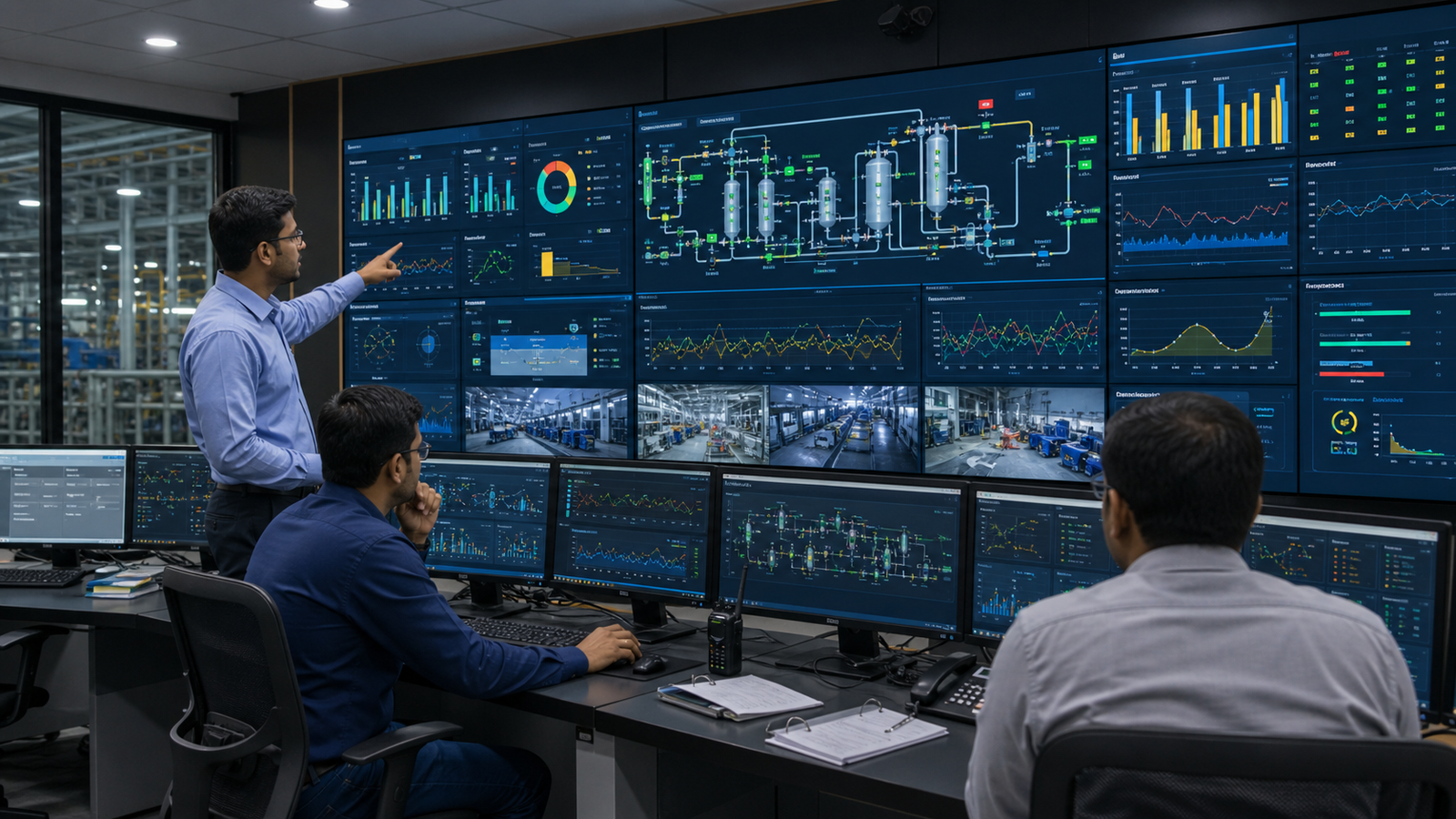
Multi-Monitor Industrial SCADA Supervision Station
Verified Field Deployment

Industrial shop-floor implementation with sub-second PLC telemetry & automated ERP synchronization.

Operational Blueprint

Harmonizes enterprise business planning, centralized control room supervision, and deterministic machine execution into a unified, fault-tolerant platform.

Our specialized application connects directly to machine controllers and enterprise systems without invasive code modifications, establishing deterministic real-time communication across industrial fieldbuses.

  • Deterministic store-and-forward buffering prevents data dropouts.
  • Sub-second transaction confirmation directly logged to enterprise records.
  • Tested compatibility across leading PLC families and SCADA environments.
Data Flow & Layered Handshake Pipeline
Level 4: Enterprise Layer SAP S/4HANA • SAP ECC • Oracle • Microsoft Dynamics PP, MM, PM, QM, CO Modules
Production Orders • Recipe BAPIs • Bill of Materials • Maintenance Notifications • Yield Confirmation
Integration Engine (Our Application) Compiled Successfully ERP-PLC Integration Bridge Sub-Second Handshake

Transactional Buffer • RFC/BAPI Connectors • Protocol Translation (OPC UA, Profinet, Modbus, MQTT) • Store & Forward Caching

Bidirectional Verification Real-Time OEE Engine Multi-Channel Alarm Dispatch Automated SAP Backflush
Level 2: Supervisory Layer SCADA • Industrial HMI • Andon Boards • Mobile Gateways WinCC, Ignition, Wonderware
Live Machine Mimics • Active Alarm Banners • Operator Recipe Selection • Shift Telemetry
Level 1 & 0: Shop Floor Machinery Siemens • Rockwell Allen-Bradley • Mitsubishi • Schneider • Omron PLCs Fieldbuses • Drives • Sensors
Machine Stroke Pulses • Temperature Sensors • VFD Inverters • Power Meters • Vision Cameras
Continuous Closed-Loop Feedback Flow:

Field Sensors → PLC Logic Execution → SCADA Real-Time Tags → Integration Middleware → ERP Production Record Update

Harmonizes enterprise business planning, centralized control room supervision, and deterministic machine execution into a unified, fault-tolerant platform.

Technical Capabilities

Core Features & Engineering Specifications

Built for high-speed industrial environments where downtime is measured in seconds.

Edge Connectivity

Hierarchical Data Flow

Aligns with ISA-95 levels, ensuring data is processed at the appropriate architectural tier without bypassing controls.

Deterministic Logic

Supervisory Line Visualization

Displays active ERP order numbers, recipe targets, and completion percentage directly on SCADA mimic screens.

Real-Time Telemetry

Synchronized Multi-PLC Dispatch

Coordinates setpoint delivery across multiple sequential machine controllers simultaneously.

Zero Data Loss

Aggregated Shift Confirmations

Consolidates counts from multiple inspection PLCs into a single unified production confirmation for ERP.

Enterprise Security

Integrated Alarm Context

Links machine trips and alarms directly to the active ERP order number for comprehensive quality investigations.

Edge Connectivity

Fail-Safe Supervisory Override

Permits authorized control room operators to pause or adjust lines safely during unexpected physical jams.

Multi-Vendor Interoperability

Hardware & Protocol Support

Direct compatibility with leading global industrial automation and ERP ecosystems.

PLC Controllers

  • Siemens S7-1500 / S7-1200 / S7-400
  • Rockwell ControlLogix / CompactLogix
  • Mitsubishi MELSEC iQ-R / Q Series
  • Schneider Modicon M580 / M340
  • Omron Sysmac NJ / NX

Protocols & Buses

  • OPC UA (DA & AC)
  • Profinet IO / Industrial Ethernet
  • EtherNet/IP CIP Generic
  • Modbus TCP / RTU
  • MQTT Sparkplug B

Field Devices

  • Barcode & 2D DataMatrix Scanners
  • Digital Multi-Function Power Meters
  • Piezoelectric Accelerometers
  • Digital & Analog Transmitters
  • Variable Frequency Drives (VFDs)

ERP & SCADA

  • SAP S/4HANA (PP, PM, QM, MM, CO)
  • SAP ECC 6.0 RFC/BAPI Connectors
  • Ignition SCADA by Inductive Automation
  • Siemens WinCC Unified & TIA Portal
  • Wonderware System Platform
Operational Pipeline

Step-by-Step Execution Workflow

How data seamlessly flows from top-floor enterprise orders to shop-floor machine feedback.

1

Step 1

Production orders released in ERP are consumed by the integration middleware.

Engineering Detail: Deterministic execution across industrial fieldbuses with sub-second handshake verification.
2

Step 2

The middleware writes active job queues and recipe parameters into SCADA supervisory tags.

Engineering Detail: Deterministic execution across industrial fieldbuses with sub-second handshake verification.
3

Step 3

Operators review the schedule on SCADA consoles and initiate coordinated line startup.

Engineering Detail: Deterministic execution across industrial fieldbuses with sub-second handshake verification.
4

Step 4

SCADA downloads synchronized setpoints and interlock permissives across all line PLCs.

Engineering Detail: Deterministic execution across industrial fieldbuses with sub-second handshake verification.
5

Step 5

PLCs stream piece counts and alarms into SCADA, while the middleware rolls up data to post completed confirmations to ERP.

Engineering Detail: Deterministic execution across industrial fieldbuses with sub-second handshake verification.
Industry Applications

Tailored Solutions for Manufacturing Sectors

Proven operational results across discrete and continuous processing plants.

Water & Wastewater Treatment

Application: Chemical dosing and pump sequencing coordinated from SCADA to PLCs and ERP in Greater Noida.

Measurable Impact: Slashing changeover lead times by 35% and automating BOM verification.

Steel Processing & Galvanizing

Application: Multi-zone heating and tension reel control integrated with ERP in Ludhiana and Jamshedpur.

Measurable Impact: 100% 21 CFR Part 11 compliant electronic batch records with zero transcription error.

Food & Dairy Processing

Application: Pasteurization and CIP batch execution coordinated via SCADA with ERP inventory in Pune.

Measurable Impact: OEE uplift from 65% to 80% through instant micro-stoppage logging.

Automotive Paint Booths

Application: Conveyor indexing and paint robot color recipes synchronized with ERP in Chennai.

Measurable Impact: Eliminating utility peak demand surcharges and optimizing furnace ramp rates.
Performance Benchmark

Traditional Methods vs. Compiled Successfully Solution

Why manual spreadsheets, point-to-point scripts, and isolated SCADA fall short.

Evaluation Dimension Traditional / Manual Methods Compiled Successfully Platform Operational Impact
Data Acquisition & Entry Manual paper logbooks or end-of-shift spreadsheet entry Sub-second automated PLC telemetry streaming & ERP posting Zero transcription error; 100% real-time data integrity
Downtime & Alert Response Local audible sirens in noisy shop floor; delays of 20-45 mins Instant SMS, WhatsApp, and mobile push notifications with root-cause context MTTR reduced by up to 50%; immediate intervention
Recipe & Parameter Download Manual operator entry on HMI keypad; high risk of human error Automated bidirectional recipe download from SAP order with 4-way handshake Eliminates wrong recipe setups and expensive scrap batches
Architectural Resilience Brittle point-to-point scripts without buffering; breaks on network drop Industrial-grade Store-and-Forward with TLS 1.3 encryption Zero telemetry loss even during enterprise network outages
Our Engineering Edge: Purpose-built bidirectional bridge between SAP ERP and multi-brand PLCs with sub-second determinism and automated mobile escalation.
Enterprise Grade

Industrial Compliance & OT Cyber-Security

Engineered strictly according to international standards for industrial automation: ISA-95 enterprise-control integration, ISA-18.2 alarm management lifecycle, 21 CFR Part 11 electronic batch records, and TLS 1.3 / mTLS outbound cryptographic security. Built-in Store-and-Forward guarantees zero telemetry loss during network drops.

Outbound-Only TLS 1.3 Encryption
Deterministic Store & Forward
ISA-95 Level 1 to 4 Data Model
ISA-18.2 Alarm Flood Suppression

Ready for a Factory Pilot?

Connect a single production line in under 3 weeks with zero line disruption.

Request Pilot Demo
Industrial Hubs Served

Nationwide Industrial Automation Deployment

Turnkey industrial automation and smart factory integration deployments across major industrial corridors in India.

Primary Industrial Corridors

  • Maharashtra (Pune, Chakan, Ranjangaon, Aurangabad)
  • Gujarat (Ahmedabad, Vadodara, Surat, Sanand)
  • Tamil Nadu (Chennai, Coimbatore, Sriperumbudur, Hosur)
  • Karnataka (Bengaluru, Peenya, Mysore, Belagavi)
  • NCR (Faridabad, Gurugram, Manesar, Noida, Delhi)

Emerging & Extended Industrial Zones

  • Telangana (Hyderabad, Pashamylaram)
  • Rajasthan (Bhiwadi, Neemrana, Jaipur)
  • Madhya Pradesh (Pithampur, Indore)
  • West Bengal (Kolkata, Durgapur, Haldia)
  • Andhra Pradesh (Visakhapatnam, Sri City)

Frequently Asked Questions

Technical and operational answers for plant managers and automation engineers.

Key considerations include defining where data ownership resides (ERP for orders/recipes, SCADA for supervisory overview, PLCs for machine logic), determining failover behavior if SCADA is offline, and ensuring strict network segmentation so that ERP traffic cannot disrupt real-time PLC fieldbuses.

Yes. We can configure bypass or direct-bridge logic in the integration middleware so that mission-critical piece counting and order tracking continue directly between PLCs and ERP during planned SCADA server maintenance.

Machine alarms captured by PLCs are passed to SCADA for operator visualization and prioritized filtering. Critical safety trips and prolonged breakdown events are simultaneously logged by the middleware to associate downtime directly with the active ERP order.

Yes. Our integration platform can interface simultaneously with multiple SCADA systems (e.g., WinCC in Building A, Ignition in Building B, Wonderware in Building C) consolidating all plant data into a single ERP interface.

We implement bidirectional handshake bits and transactional status flags at every layer. The PLC confirms receipt of setpoints to SCADA, SCADA confirms execution to the middleware, and the middleware confirms completion to ERP, ensuring complete auditability.
Free Demo Available

Ready to Improve Your Factory Alarm & Alert Management?

Discuss your PLC, SCADA, machine monitoring, IIoT or Industry 4.0 requirement with our industrial automation team. See how PLC events, SCADA alarms, machine downtime and industrial conditions can be monitored through web dashboards and mobile alerts.

Serving manufacturing plants across Delhi NCR, Haryana, Maharashtra, Gujarat, Tamil Nadu, and PAN India
Call Now WhatsApp Request Quote